Friday, May 24, 2013

Archive for October, 2011

Boomers Arriving at 65: The Stability Survey™
Stability Survey.001

We neither get better or worse as we get older,
but more like ourselves…Robert Anthony

The boomers are landing on the shore of old age at a rate of 12,000 a day. While turning 65 is officially classified as “young-old,” there is little doubt this is a quantum shift in the boomer lifecycle. As important, this transition is not just leaving behind middle age bodies; it is also about leaving behind middle age psychology. The developmental tasks of fifty-something are being replaced by the tasks of seventy-something. Adding to the complexity of this transition is the persistent turbulence of post-meltdown world. Now what?

What would be helpful at this juncture is a simple way for boomers to assess personal stability, a tool that could provide them with:

1. An overview of the status of key personal resources
2. Feedback about strengths and deficiencies
3. Insights to set realistic expectations and goals

I have created a new self-inventory questionnaire that does this called “The Stability Survey?.”

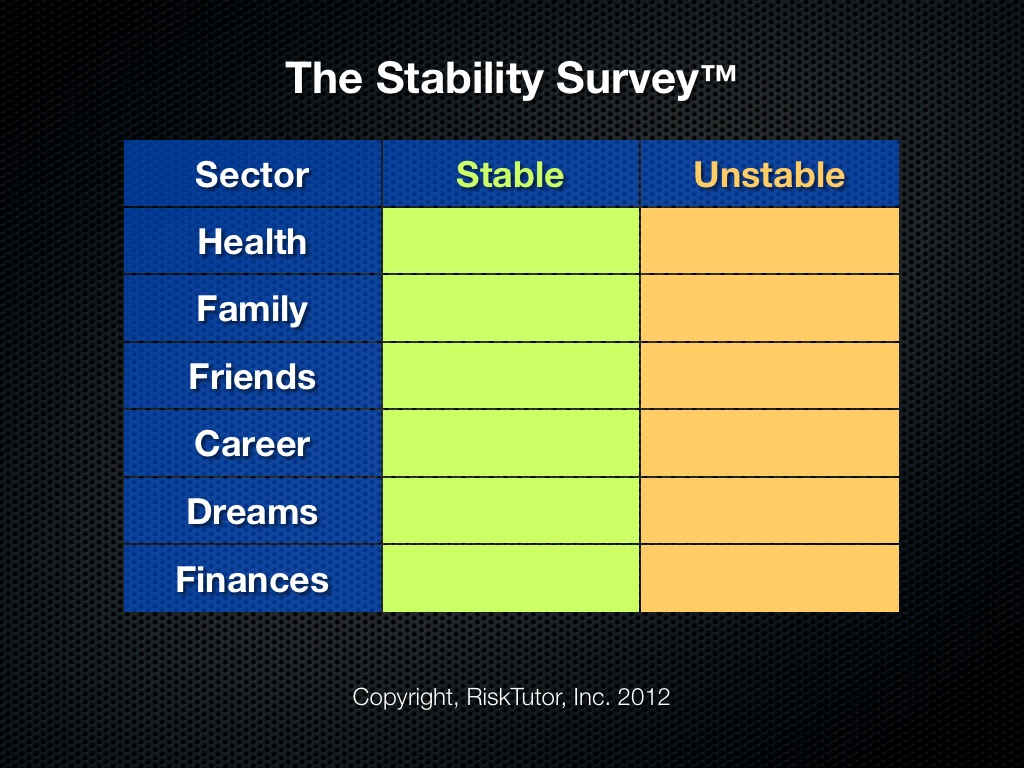
The Stability Survey? is a yes-no questionnaire that provides a snapshot of boomer transition assets. There are no right or wrong answers or scoring, just a “holding its own” (stable) or “not doing so well” (unstable) assessment of six broad sectors that impact both quality of life and optimal aging.

Here are the six survey questions:

How is your health?
How is your family?
How are your friends?
How is your career?
How are your dreams?
How are your finances?

Here are some of the implications of the answers for each sector:

Health Status
Stable health usually means no medical issues or medical issues that are under control. Unstable health usually means emerging medical issues or existing medical issues that are either drifting or officially out of control.

Family Status
Stable family usually means normal or abnormal family issues that are under control. Unstable family usually means normal or abnormal family issues that are either drifting or officially out of control

Friends Status
Stable friends usually means close friends who provide comfort and support. Unstable friends usually means issues with close friends that are undermining comfort and support

Career Status
Stable career usually means implementation of a personal retirement plan including post-retirement work. Unstable career usually means unresolved work issues or unsatisfactory retirement planning.

Dream Status
Stable dreams usually means the emergence and pursuit of longstanding or new passions, interests, callings, or pursuits. Unstable dreams usually means the loss of deeply personal dreams or the belief they are attainable.

Financial Status
Stable finances usually means implementation of a pre or post personal financial plan Unstable finances usually means unresolved financial issues or unsatisfactory financial planning.

The Stability Survey? is both a look back at where boomers have been and a look forward to the mission that lay ahead. In developmental terms, it shows which transition assets are in alignment with the tasks of the final phase of life: control and legacy. Conversely, it quickly highlights which of the six resources could potentially undermine them. This “big picture” view at the gateway to the next twenty and possibly thirty years could prove invaluable to boomers who are searching for clarity and direction to help them preserve quality of life as well as promote optimal aging.

Search

David Solie Updates

Sign Up for David Solie Updates

* Required field

*

*

*


Email Marketing by VerticalResponse

Communicate

David’s New Book


David Solie’s new book Caregiver Mind Maps is being acclaimed as “tangible breakthrough” in communicating with aging parents...

Learn more about this revolutionary approach in caregiving, download a sample, and order your copy here.

Blog-Talk Radio Show

Aging Parents Insights
Radio Show

Aging Parents Insights, hosted by David Solie, is a blog radio show that provide listeners with "new ideas and strategies” for understanding and communicating with aging parents.

No Money: No Comment

I was recently asked what to do about aging parents who had little or no savings but refused to discuss any aspect of their “money issue.” It reminded me that our role as adult children is not necessarily about problem solving; it is about compassionate containment. So many of the issues we feel compelled to “fix” have no clear answers. The best we can do is sort out what to accept from what we can actually change. Here was the advice I offered:

The issue of money, like so many other issues in the last phase of life, is about control. The best way to approach it is to reframe money as means of maintaining control. Lack of money takes away control. This link will take you to an article I authored on “communicating touch choices” that offers a practical strategy for how to do this:http://www.aging.org/i4a/pages/index.cfm?pageid=2103&textonly=1

You may also want to consider three strategies that will help you “hedge” your parent’s financial risk:

1. Buy a long term care policy with a two years home care/two years nursing home benefit. This assumes they will cooperative with the process (i.e. signing the applications and answering questions).

2. Start funding a dedicated “side fund” for expenses that a long term care policy will not cover.

3. If you parents own their home, become familiar with how “reverse mortgages work and when they make sense.

Lastly, you need to began discussions with local area agencies on aging to determine what, if any, community resources can assist your parents if they run out of money.

This is a tough end-game, especially if you parents don’t want to talk about. The article will help you frame your conversations. Be patient but persistent in your discussions about control and your desire to help them maintain it.