Saturday, February 04, 2012

Posts Tagged ‘When the bottom falls out mind map’

When The Bottom Falls Out Mind Map ™

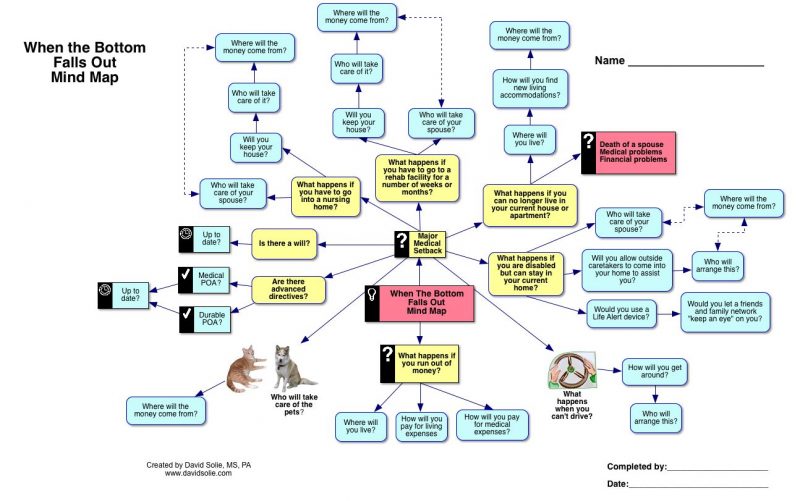
Here is the When The Bottom Falls Out Mind Map ™ that I created for a family where the aging parents told their adult children they were going to wait until they “needed to plan” (Double-click on the image to enlarge it).

The goal was to provide the adult children with a way to visually show their parents the type of decisions that would have to made if the bottom falls out. They simply told their parents they would “do their best” when things fell apart and gave them a copy of the mind map. These are the things we are going to have to decide with or without you they said. No scolding. No lecturing.

A few weeks later their parents brought up the mind map. They had some questions. It was a start.

We are all visual people. Check lists, brochures, and passionate pleas may fall on deaf ears. But a mind map lays out the interconnecting parts, a global view of the complexity that lies ahead. In essence, the When The Bottom Falls Out Mind Map ™ is the current marching orders until further notice. One way or another, it helps settle what really is going to happen…

Search

David Solie Updates

Sign Up for David Solie Updates

* Required field

*

*

*


Email Marketing by VerticalResponse

Communicate

No Money: No Comment

I was recently asked what to do about aging parents who had little or no savings but refused to discuss any aspect of their “money issue.” It reminded me that our role as adult children is not necessarily about problem solving; it is about compassionate containment. So many of the issues we feel compelled to “fix” have no clear answers. The best we can do is sort out what to accept from what we can actually change. Here was the advice I offered:

The issue of money, like so many other issues in the last phase of life, is about control. The best way to approach it is to reframe money as means of maintaining control. Lack of money takes away control. This link http://www.dsolie.com/articles/reframing.html will take you to an article I authored on “communicating touch choices” that offers a practical strategy for how to do this.

You may also want to consider three strategies that will help you “hedge” your parent’s financial risk:

1. Buy a long term care policy with a two years home care/two years nursing home benefit. This assumes they will cooperative with the process (i.e. signing the applications and answering questions).

2. Start funding a dedicated “side fund” for expenses that a long term care policy will not cover.

3. If you parents own their home, become familiar with how “reverse mortgages work and when they make sense.

Lastly, you need to began discussions with local area agencies on aging to determine what, if any, community resources can assist your parents if they run out of money.

This is a tough end-game, especially if you parents don’t want to talk about. The article will help you frame your conversations. Be patient but persistent in your discussions about control and your desire to help them maintain it.